
ANSH: I suppose i’m intrigued about what part of your homeland provided you with your most formative memory of that place?? is there any particular moment which stood out to you??
YASMINA: Homeland… is a very difficult term for me. Maybe difficult is not the word. When I think about homeland, I cannot think of just one place. I think of two cities: my Mom’s city, Beirut, the city I was born in, and my Dad’s city, Rome, where I spent most of my life.
Homeland is two cities.
Wait, oh my God, I keep re-reading this question and I’m like, “I need to crawl inside my own brain.” I mean, I’m allowing you to crawl into my brain, but I need myself to allow me to do that.
Formative memory, ugh! Okay, I say this in a lot of answers and interviews, but I think some of the most formative experiences for me do not come from a place, they come from people. I’m a very relational kind of person. I think we all are frickin relational people and we grow through relationships. I want to say that what formed me happened outside of my homeland lol, so it makes it even more complex. But I think probably leaving.
Leaving it.
The departure.
That’s my answer.
I’m sorry, it’s probably not the answer you wanted, but I think you really need to leave a place to also understand what’s holding you back in life, you know? It’s not like leaving parts of you in that place, but for me it’s more, “I allowed myself to do things here in Paris, but also in Madrid and in Brussels, other places where I lived, that I would have never allowed myself to do in Rome,” and I think that that is definitely just the way I see it.
A particular moment which stood out to me, I think, was my graduation. For my MASTER’S. Not related to what I just said, so I’m probably going to sound stupid, but graduating from my master’s was actually interesting because I struggled so much with the subjects I was studying, and now I do a job that’s completely different from what I studied, but, you know, it was a moment filled with pride. And I wrote a frickin dissertation for months, 100-something pages on, like, critical infrastructure. I can’t even remember the title now, but cybersecurity, critical energy infrastructure, like cyberattacks and stuff. I was like, wow, I can do stuff, and I can do a million crazy different things.
ANSH: Another question would be which piece of culture/media stands out most to you and why??
YASMINA: I think there are a few cultural PEOPLE that have really shaped the way I look at people, but for completely different reasons, and I don’t know if they necessarily make sense together.
The first person I always think about is Tracey Emin.
I think I love her because there is almost no separation between the work and the person. Everything that could potentially be embarrassing, humiliating, too intimate, too sexual, too sad, too much, she somehow puts it there. And I think I’m very attracted to people who do that, who take the things that you’re supposed to hide and make them the material.
And then, on a completely different side, Oriana Fallaci.Especially her interviews.
I think I’m obsessed with the idea that an interview doesn’t necessarily have to be neutral. Fallaci is THERE. You feel her. You know what she thinks, you know when she’s irritated, fascinated, suspicious, seduced, whatever. Sometimes the interview almost becomes a confrontation between two personalities rather than one person disappearing in order to document the other.
And I think that has definitely influenced Palomita, because I don’t really want to disappear from my interviews either. I’m not a journalist and I’m not trying to pretend that I am objective. If I’m interviewing you, there is a reason I chose you. There is already affection, curiosity, fascination, history, sometimes even tension. I think pretending that none of that exists would actually make the interview less honest.
Then there’s Bluets by Maggie Nelson, which I love for a completely different reason.
I love the fragmentation of it.
The fact that you can obsess over one thing, in her case the colour blue, and somehow through that one thing talk about love, loss, sex, loneliness, memory, pain, philosophy, completely unrelated things, and yet they all start belonging together.
I think my brain works a little bit like that.
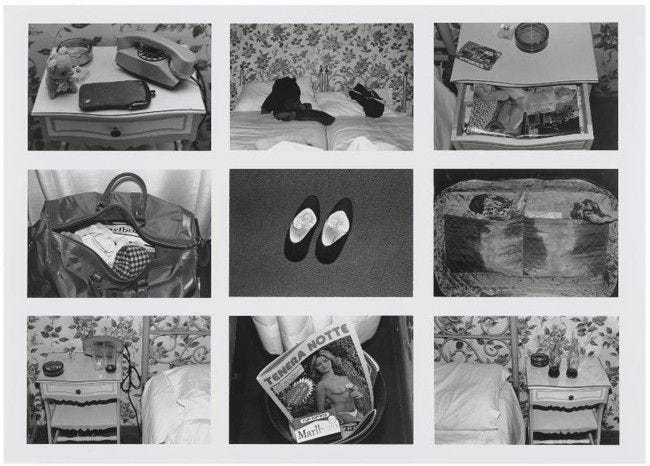
I love fragments. I love when something very small suddenly opens into something enormous. An object, a colour, a song, a chair, something someone keeps next to their bed. Sometimes those things tell me more about someone than asking them directly who they are.
And Sophie Calle, especially Exquisite Pain.
I think that work really stayed with me because she takes heartbreak, which is something so private and honestly sometimes so embarrassing because you feel like nobody has ever suffered as much as you have, and she turns it into almost a system.
She repeats the story. She documents it. She asks other people about their pain. The repetition changes the thing.
I love that.
The idea that you can take something that hurts you and look at it again and again and again until it becomes something else. Maybe not something less painful, but something you can observe.
And maybe that’s also why I’m so interested in archives.
Keeping things. Recording things. Taking pictures of objects. Saving conversations. Going back to the same story from different angles.
More recently I’ve also been thinking about Bella Freud’s Fashion Neurosis, because I love the idea of using clothes almost as a psychological entrance into someone.
You ask someone about a jacket and suddenly they’re talking about their mother.
You ask about a pair of shoes and suddenly you’re talking about insecurity or who they wanted to be when they were seventeen.
And I think that’s what I love culturally in general: things that start somewhere apparently superficial or extremely specific and then accidentally reveal something much bigger.
Maybe that’s the connection between all of them actually.