


I think what fascinates me about certain people is that they can become important in our lives without necessarily knowing it.
I met Sam on a bike.
I had started spinning for a reason that, at the time, had almost nothing to do with me: the guy I was seeing cycled a lot, and somewhere in my head I wanted to understand his world a little better. Little did I know spinning had nothing to do with cycling. But whatever.
Then something quite funny happened. Spinning gradually stopped having anything to do with him.
It became mine.
I remember my first class with Sam, on a Sunday evening, I think, in Sèvres. I had dragged Benedetta and Ludovico along with me. Since then, there has been a lot of music, a lot of Lady Gaga, a few threats involving extra minutes of arm exercises, and above all this very particular feeling of being pushed while still feeling safe.
And then there is one sentence.
I remember hearing Sam say, towards the end of an effort: “It’s going to stop.” I’m not even sure she says it often. Maybe I only heard it once. But it stayed with me long after I left the studio.
So I wanted to know who the person behind the microphone is.
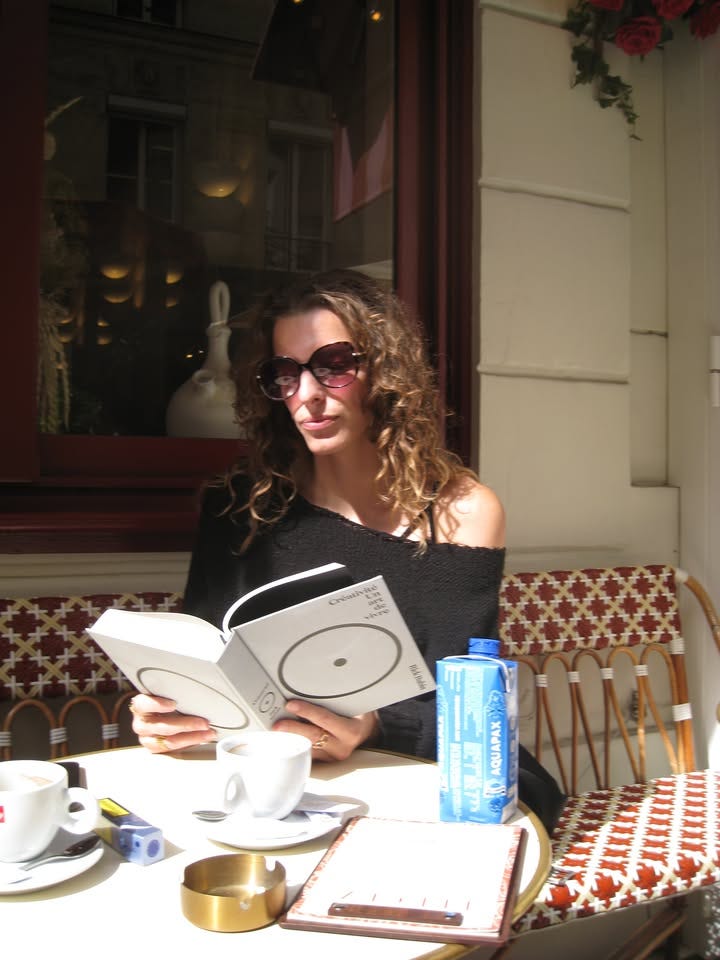
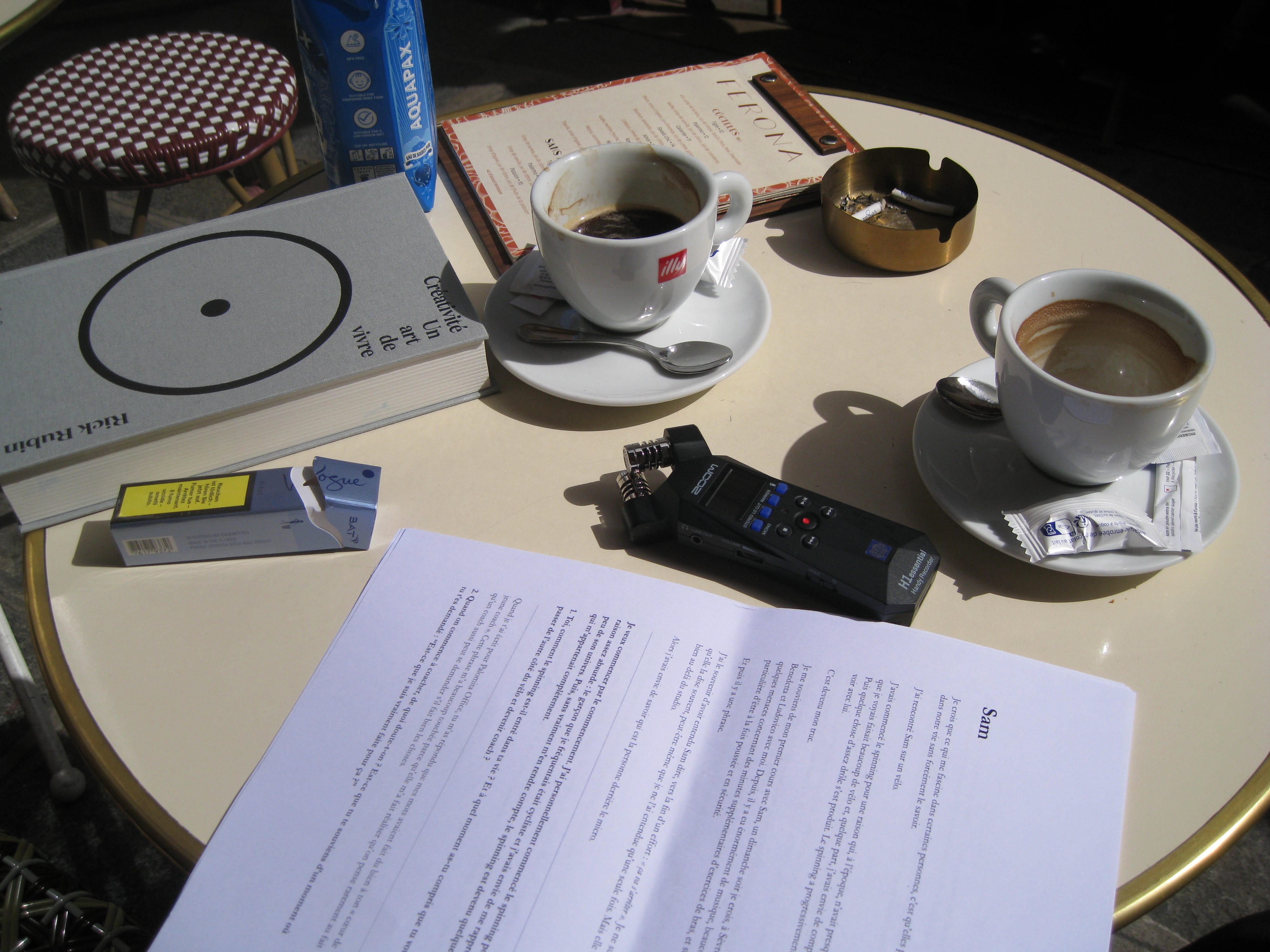
I meet Sam in a café near Concorde during my lunch break. I’m stressed. It’s one of my last weeks at work, I don’t want to be late getting back after lunch, but at the same time I care so fucking much about this interview. The first thing I notice is her book. She’s reading The Creative Act: A Way of Being.
Sam: It’s insane, girl. I started it yesterday. I was having such a shit day, like genuinely awful. And I thought to myself: what would make you happy right now? I’d already saved the book somewhere, so I thought, you know what? Go to a bookshop, buy yourself the book, sit down on a terrace.
Reading without rules
Yasmina: Do you read a lot in general? Do you actually manage to find the time? I can’t. There are too many things. Sport. This. Work. The dog. I’m always so curious to ask the people I interview: how do you find the time?
Sam: I read a lot. I try not to impose a ritual on myself where I have to read a certain number of pages every day. I think reading, like any pleasure, shouldn’t become an obligation. But if I’m at home and I have to choose between spending an hour on my phone and reading, I’ll choose reading. It’s about telling yourself: OK, I know I could disappear into an endless scroll until two in the morning, but no, I don’t want that.
Yasmina: Exactly. Sometimes I end up on Instagram watching grandmothers explain how they wash their dishes. It’s cute, but I’m not sure I really need it.
Sam: It’s so much brainrot! We get completely sucked into it. Not long ago, I watched a report on YouTube about the effects scrolling can have on your brain, and I thought: girl, this is serious. There are also so many authors I want to read, and I’m still feeling my way around what I actually want to read. I let myself be inspired too. Sometimes you hear someone mention a book, you ask your friends. I have a friend who works at a publishing house and reads an enormous amount for work, so depending on what I feel like reading, she’ll often point me towards something. But I try to read as much as possible every day, even if it’s only ten pages.
Yasmina: It’s nice to give yourself a goal.
Sam: Yes! But it can’t become a constraint. You shouldn’t be telling yourself, I have to finish this book in five days. But if you want to, you can!
Yasmina: A bit like challenges.
Sam: Like challenges, girl.
Welcome to the jungle
Yasmina: I got into spinning because I wanted to get inside the head of a guy who cycled, like gravel cycling. And I thought: what can I do in Paris that’s somewhat similar? And I found spinning. After that, it had absolutely nothing to do with him anymore, but I became addicted. When I walk into that room, I know I’m going to feel so good afterwards. Recently I’ve been coming a little less often, but the effect is still the same. How did you first get into spinning?
Sam: Four words: Welcome to the Jungle. I was looking for a student job and I was on the site when I saw they were looking for front-of-house staff at Dynamo. I didn’t know the brand at all, and I knew nothing about the concept of spinning. I knew it existed, but I’d never really encountered it. I started working as front-of-house staff in the studios. I was the one welcoming people, giving them their shoes, helping new people get set up. The first time I saw the whole thing, my immediate reaction was: what kind of cult is this? The people almost scared me. I didn’t understand the point of the activity at all. Then, after about a year and a half, one of the coaches, Vinz, who isn’t at Dynamo anymore…
Yasmina: I think I took some Rise classes with him! I messaged him once because I loved his playlist. And it’s so important.
Sam: Yes, his music was amazing. Music was everything. Vinz and I used to talk a lot, and one day he said to me, “Girl, why don’t you audition to become a coach?” I looked at him and said, “Vinz, that’s sweet, but I am absolutely not a coach.” And he said, “Who cares? They’re looking for personalities. You have a great personality. Train and go for it.” I wasn’t very convinced at first, but the idea started growing on me, and I thought: actually, there’s something really cool about bringing people together around something, making playlists, taking people with you. Creating this journey. I thought about it and then, a few months later, I was coming home from a night out, I was a bit drunk, and I imagined myself on the bike with a song playing, teaching a class. I imagined the energy, and that was the first time I could actually feel it. I thought: girl, there’s something here.
Yasmina: Beautiful.
Sam: I did the first audition, which basically involves filming yourself teaching a class. I did it with a lot of enthusiasm and genuinely wanting it, but without expecting too much. I kept thinking: I’m not a sports coach! And then I passed. I did the second audition and after that I went into training. During training, you’re doing cycling eleven hours a week. It basically becomes your whole week, and that’s when it gets really intense. You start asking yourself: am I doing this for the fame of being up on a podium? Or do I genuinely like this? And I started developing a real love for Dynamo, for cycling, for sport, for coaching. That’s how I really got into it. After seven or eight months of training, I taught my first class and I never stopped. I love it.
Yasmina: You said there was a song playing when you imagined yourself on the bike. What was it?
Sam: It’s called Rise. I can’t remember who it’s by. I was walking home and imagined myself on that podium creating this energy, and I thought: yes, I think I like this. There’s a part of me that really wants to go for it.
Yasmina: Sometimes that happens to me when I’m listening to Lady Gaga. I think you played Garden of Eden once, and I’ll be on the bike thinking, OK, let’s go, and I start doing the spinning positions again, elbows at four and everything.
Sam: Once you start Dynamo, it follows you outside the studio! There’s something so instinctive about it. And it means you genuinely like the discipline. When I started doing the auditions, I realised that whenever I listened to music in my headphones, I’d imagine myself moving to the rhythm and teaching a class. And I thought: wait, girl, you have the opportunity to audition. Just go for it. You have nothing to lose anyway.
Building a journey
Yasmina: I’m fascinated by the idea of seeing what music you’re going to bring out every time. I loved the electro mornings. I feel like they connected perfectly with my brain at 7:45 a.m., and I loved the mix you did the other day. Music without lyrics, Flume… When do you make your playlists during the week? Without giving away all your secrets!
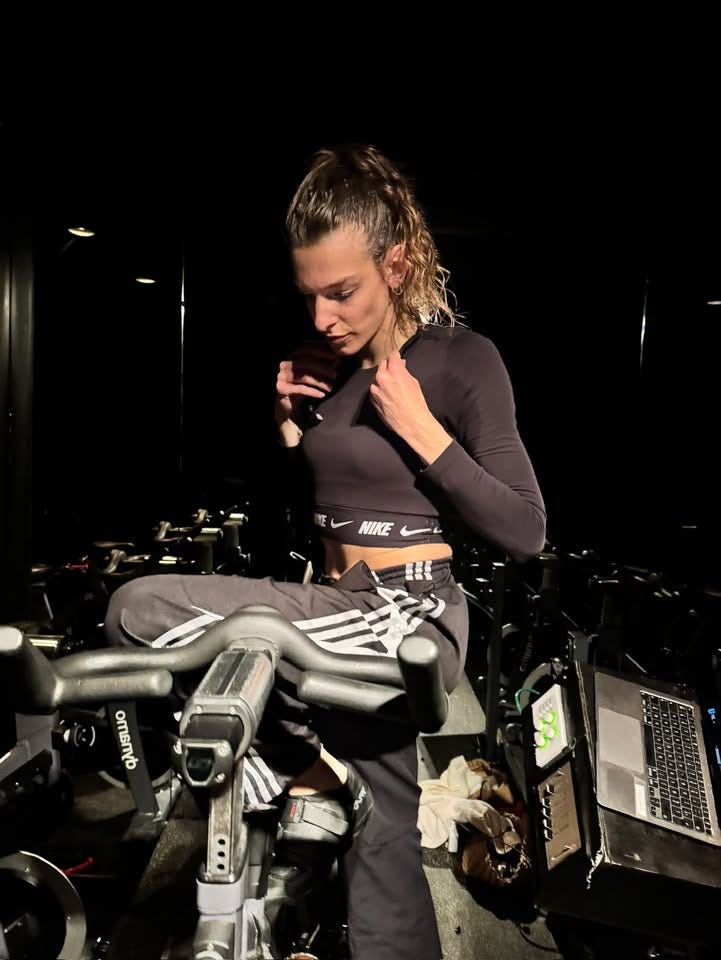
Sam: There are no secrets, my love. Most of the time, I think I start at the beginning of the week. My week starts with my Monday 8:30 p.m. slot, which I love. It’s amazing. It’s where I know the most people and where I feel the most comfortable. With music, it usually starts because I hear something in my headphones. I spend most of my life with headphones in my ears, and sometimes I get this feeling where I think: OK, I’m going to build the whole playlist around this track. The structure depends on what I want to communicate. Sometimes I think: I want this to feel bright and joyful, we’re dancing, going crazy, singing. Other times I think: no, we’re going deep into immersion. And then the music changes accordingly. If I want immersion, I’ll choose electronic music without lyrics. It really depends. A morning playlist is completely different from an evening playlist. The morning is such a delicate moment for the body, so you need to build things gradually. But at 8:30 p.m., you’ve already lived through an entire day. You have to start strong!
Yasmina: When is your first morning class of the week?
Sam: Wednesday!
Yasmina: How can you tell when a playlist has worked?
Sam: It’s about coherence between the tracks. Sometimes I listen back and think: yes, this works. There isn’t that moment where you go, wait, why is this here? Transitions are what matter most. When we finish something really intense, I like bringing the energy down without actually losing it. That’s where something like Flume works really well, for example. And on Monday it landed at exactly the right moment.
Yasmina: Is managing the playlist during the class stressful?
Sam: When I started, massively. During my first sessions, I overthought everything, obviously. When you’re starting out, you really want people to have a good time, but at the same time you’re full of doubts. I think things really start working when you tell yourself: OK, my goal isn’t to please everyone anymore. My goal is to be authentic in what I’m offering. That applies to the music you choose and to the words you use. At the beginning, I chose songs I imagined people wanted to hear. A lot of pop. I love pop, obviously, but I also love exploring that electronic side. Since I started allowing myself to do that, I’ve been much happier. That’s also why I hate specials that are 100% one artist or one thing. It restricts me too much in terms of what music I can choose. The sensations are so much more beautiful and powerful when you switch from one genre to another. It’s a journey.
Yasmina: I love when you take those little moments to dance. It gives me so much energy because I can see that you’re there to have fun too.
Sam: I’m not going to ask you to enjoy yourselves and bring fun into your sessions if I’m standing there not doing it myself. Everything gets transmitted. It’s all energy. But I dance because I actually want to dance, not because I’m trying to hype people up. I do it because I want to enter into something more physical, more present.
Divas vs DJs
Yasmina: And your Diva vs DJ concept?
Sam: Very good question. I think at first there was already this marketing idea of saying: I love pop and I love electronic music. For the first two Diva vs DJ classes, I chose the artists myself. Then at some point I thought it could be interesting to create votes and let people choose. And suddenly I’m creating a whole new experience. I get to work on transitions and mix different universes together. I love it so much, it’s insane. Lady Gaga vs Daft Punk was one of my favourites.
Yasmina: Why divas?
Sam: Because most of what I listen to in my headphones is women. I don’t know why, but female voices move me much more than male voices. They affect me much more. Maybe there’s something about identification in there. Men’s voices can annoy me very quickly. I don’t think I really have a favourite male singer. I love Prince. But women’s voices give me chills. DJ, because I still think the majority of DJs are men in 2026, although it’s nice that more and more women DJs are coming through. But again, it’s a way of bringing together pop and electronic music, which are really my two worlds.
Yasmina: Top divas? Give me your top three.
Sam: Lady Gaga first, obviously. Second, I’d say… I grew up with Céline Dion. I got my tickets for September 23rd! A friend texted me, ‘Girl, what are you doing on September 23rd?’ I said, ‘I don’t know, why?’ And she asked me to go to the concert with her! I was so, so happy!
Yasmina: When I was seven, I used to film myself on my mother’s iPad singing Céline Dion.
Sam: I feel like so many of us grew up with Céline Dion. She’s been with me throughout my whole life. She isn’t necessarily the person I listen to most on my phone today, but this woman conquered the world. My third is probably a newer diva, or one who’s re-emerging: Agnes.
She used to sing Release Me. Then she disappeared for five years and came back with a whole new flow, new music, and it completely blows my mind. That was the first song I played on Monday.
Yasmina: And that very first song is important.
Sam: Yes, it’s the most important one. I put on a waiting track before I enter the studio, then I turn that down, launch the playlist and go.
Yasmina: The biggest achievement when you start doing Dynamo…
Sam: What?
Yasmina: When you finally start clipping in and unclipping by yourself!
Sam: Yes!
Yasmina: And you know when you stretch at the end, are you supposed to unclip and then clip back in?
Sam: There are no rules. You listen to your body when you stretch without overthinking it.
The person on the podium
In the meantime, we order our second round of coffees.
Yasmina: Can we talk about your role as a coach? I wonder whether you have doubts. When I see you, you’re so cool, you’re strong, you look confident. Doubt is human. So I wonder: what are your doubts as a coach?
Sam: I think being a coach partly means doubting yourself all the time. But you have to find the right balance. The kind of doubt that galvanises you and pushes you to keep offering something you actually care about. Sometimes I’m in the studio thinking: fuck, what am I even saying right now? Or I’ll say something during the class and immediately wonder whether everyone thinks it sounded weird.
Yasmina: And there’s also a kind of responsibility that comes with being on that podium, right? People listen to you. They trust you.
Sam: You can genuinely brainwash people in this job, so you have to be careful. It’s a bit like white coat syndrome: when someone presents themselves as a coach, or as a doctor, there’s this instinctive reaction of, “She’s right, she knows.” I actually try to encourage people to deconstruct that. If you find something therapeutic in my classes, amazing, that makes me really happy, but my goal isn’t to be your therapist.
We don’t create for an outcome
Yasmina: I see it with my interviews too. I love my project, but I also have doubts. Sometimes I think: what if nobody reads it?
Sam: You have to stop caring about the outcome. Followers, Instagram, all of that is so ungrateful. The people with the most followers are not necessarily the people producing the best things. You need to create some distance between yourself and follower counts and all of those things.
Sam: We don’t create for an outcome. Creating comes from a need to share, to give things meaning, not simply to be appreciated for what you make.
Yasmina: There are so many versions of what we do. There are lots of spinning coaches, just like there are lots of media projects doing interviews.
Sam: But there isn’t one single truth.
Everyone has their own truth. And the sun shines for everyone. You shouldn’t feel threatened by other people existing. Being better than someone else doesn’t mean anything. You just need to trust yourself, trust what you’re offering, explore, and always doubt yourself. Keep doubting.
Do it with the doubt
Yasmina: When you doubt yourself a lot, who or what gives you that confidence back? People, rituals, references, music?
Sam: I love that question. When I doubt myself, I think about how lucky I am to be so well surrounded. My friends are my guardian angels. I genuinely think that a huge part of what I manage to accomplish in life comes from the fact that I’m so well supported.
But when I doubt myself, I also tell myself: girl, do it with the doubt. Do it with the anger, the joy, the excitement. Just do it. And once you do, you realise very quickly that whatever is moving through you at that moment can become fuel and bring out something real. And I don’t think you ever completely get rid of doubt.
You shouldn’t feel threatened. You can’t fail as long as you’re actually doing it.
You are plural
Yasmina: I love what you’re wearing. Can you tell me about it?
Sam is wearing a mini skirt and boots that I had already noticed before class and loved.
Sam: Today I wanted to feel stylish but casual, still a little relaxed. I think we’re unconsciously guided by the clothes we wear much more than the other way around.
Yasmina: I’m so inspired by the podcast Fashion Neurosis by Bella Freud, which revolves around exactly this idea. She looks at clothing as a vehicle for emotions and feelings. She interviewed Lorde, who I love.
Sam: There’s a video of Lorde on Instagram that absolutely killed me. She sings this line about being her mother’s child and then shushes the crowd. Epic. I was watching it like, oooh, this is making me laugh so much.
Yasmina: I saw her at Rock en Seine and the energy and visuals were insane. Anyway, going back to style, the thing is that when I go and see someone, I dress differently depending on the person, and it always makes me think so much.
Sam: Totally. But I like the idea of different versions of yourself. You’re plural. And clothes allow you to show the different pluralities inside you. I have a grunge part of me, a more casual part that doesn’t give a fuck, a really feminine and sensual part, and it’s so nice to explore all of that. Today I woke up and thought: I want to explore this vibe. I want to look beautiful, feel fresh. And on other days, I couldn’t care less.
Back to black
Yasmina: What does your wardrobe look like?
Sam: It’s a complete mess! But I actually don’t have that many clothes. I recycle a lot of things. I’m not a huge clothing consumer. But sometimes I’ll suddenly think: OK, right now I want this specific piece and that specific piece because I want to create something. Skirts, dresses, oversized shirts.
I wear a lot of black, white and solid colours.
Yasmina: I love that. I had a huge colour phase this spring: pink, blue, yellow. But I got a bit tired of it. Back to black.
Sam: Colour is hard, I think. It isn’t like black and white, which go with everything. When you have something colourful, you have to make sure it’s going to work with everything else.
Yasmina: A question I ask everyone on Palomita Office now: what would we find if we opened your Vinted page right now?
Sam: I think you’d find long black dresses because that’s what I’m looking for right now. So yes, an insane number of black dresses. Something I can wear to a bar or on a date without looking too dressed up, because I think long dresses can look very, very dressed up really quickly, you know? And suddenly you’re standing there thinking: OK, this is a bit too much.
And I found it! So I can’t wait for it to arrive.
Rapid fire
Yasmina: Ready for the last part of the interview? No thinking on these questions.
Sam: Ready.
Yasmina: A track you could start your classes with and never get tired of?
Sam: I Trance by Agnes.
Yasmina: A track you love but can never quite make work in class?
Sam: I’m an Aries rising. No track is impossible.
Yasmina: The ultimate diva?
Sam: Gaga.
Yasmina: Morning or evening?
Sam: Evening! Evening, by far!
Yasmina: One essential quality in a good coach?
Sam: Empathy.
Yasmina: The best track to end a class with?
Sam: Wash. I forgot who sings it.
Yasmina: One word for discipline?
Sam: Rigour.
Yasmina: Sport?
Sam: Health.
Yasmina: Music?
Sam: Vibration.
Yasmina: Paris?
Sam: Intense.
Yasmina: One word for Sam?
Sam: Courage.
Yasmina: For me?
Sam: Light.
Yasmina: Your favourite word?
Sam: GOÛTER!