

I have always been fascinated by people who build worlds of their own. Not necessarily imaginary worlds, but ones so specific, so full of private references and strange little details, that you begin to wonder whether they exist somewhere outside the person who invented them.
Joseph Arzoumanov is one of those people.
I visited him at his atelier in Paris, where almost everything seems to have a story attached to it. A crown made from bullets he collected as a teenager in a Second World War bunker. A ring in which a tiny mechanical heart beats when you turn a crown. A chess set populated by kings, queens, and other characters whose clothes have been designed with the seriousness of an entire fashion collection. One of the rooks has lost his heart and spends eternity carrying it up a staircase. I found that particularly upsetting, in a good way.
I had prepared questions about jewellery, craftsmanship, fashion, and the relationship between objects and the people who make them. We ended up discussing medieval fools, childhood treasures, Armenian volcanic stone, bad dreams, and the rather ambitious project of building a palace.
What interested me most was Joseph’s relationship with imagination. He tells me that he remembers having bad dreams almost every night, and that creating things allows him to transform those impressions into something harmless, even comforting. I like the idea that an object might exist not only to be admired, but to protect someone from something.
At some point, he showed me a miniature portrait of his grandmother, made in white gold, with rubies in her cheeks and diamonds in her eyes. Inside, he had sculpted her dreams. I didn’t really know what to do with that information, except ask more questions.
We began in the atelier, surrounded by unfinished objects, drawings and tools, and eventually continued our conversation over drinks. I was supposed to be interviewing a jewellery artist. Instead, I found myself wondering about the difference between inventing a world and discovering one.
Perhaps there isn’t much of a difference.
This is Joseph Arzoumanov, and a few of the things that exist inside his head.
SOMETHING A LITTLE MORE NATURAL
LPT: What does a typical day look like? I’m actually going to ask Joseph the same question.
ALIENOR: It’s funny because a typical day is usually one where you think you’ve planned everything.
LPT: And then completely different things happen.
ATELIER: Exactly.
We work while listening to music. Then we’re constantly interrupted by different things. There’s the administrative work, Joseph drawing, working on jewellery, checking the quality of everyone else’s work.
And then there are all these little side quests.
Going to galleries to deliver works, meeting clients, attending exhibition openings.
No two days are really the same.
LPT: That’s what makes it exciting, I think.
ATELIER: Completely.
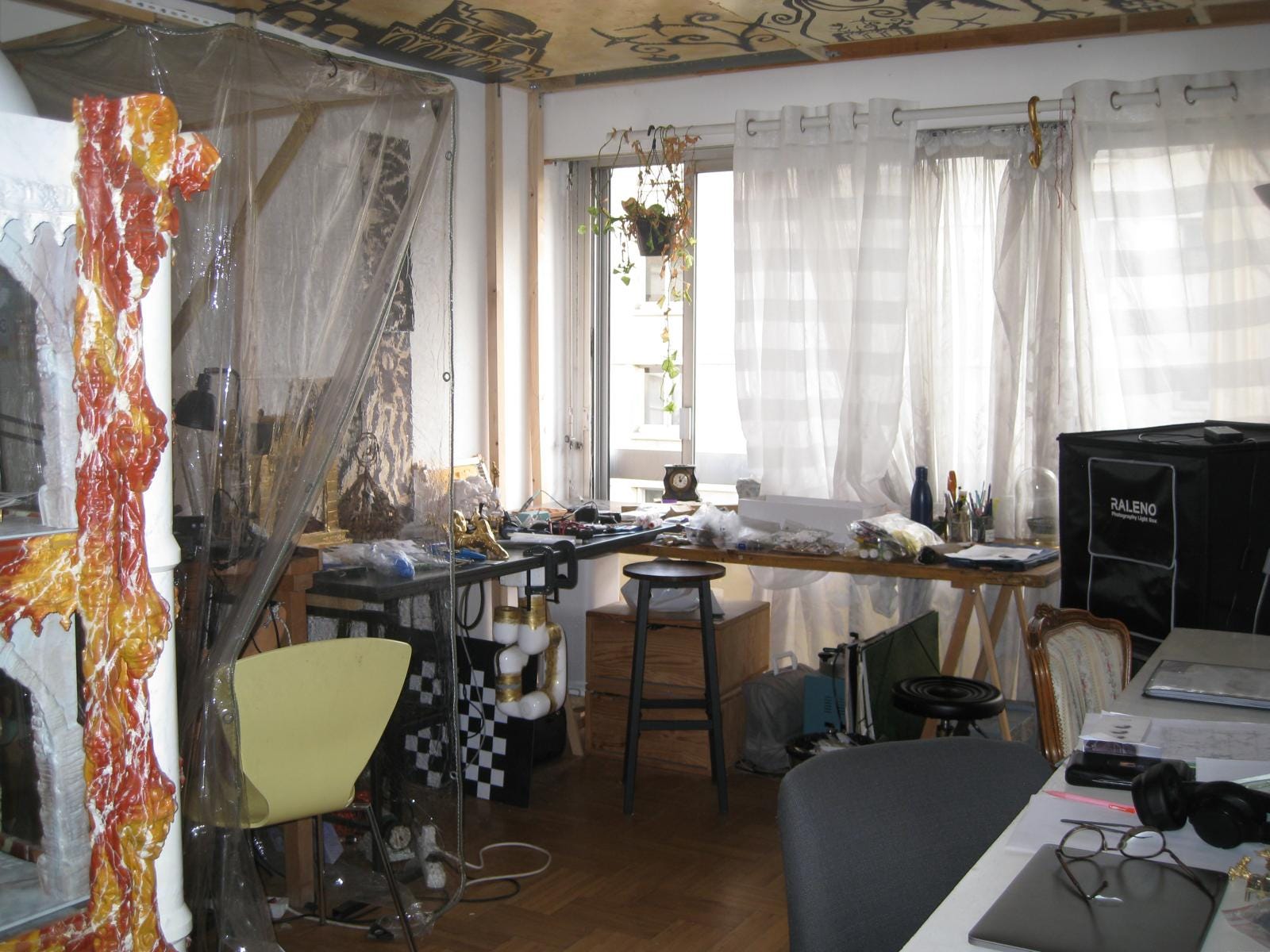
A CROWN MADE OF BULLETS AMONG OTHER THINGS
LPT: I’m trying to photograph stuff. For example, what’s this?
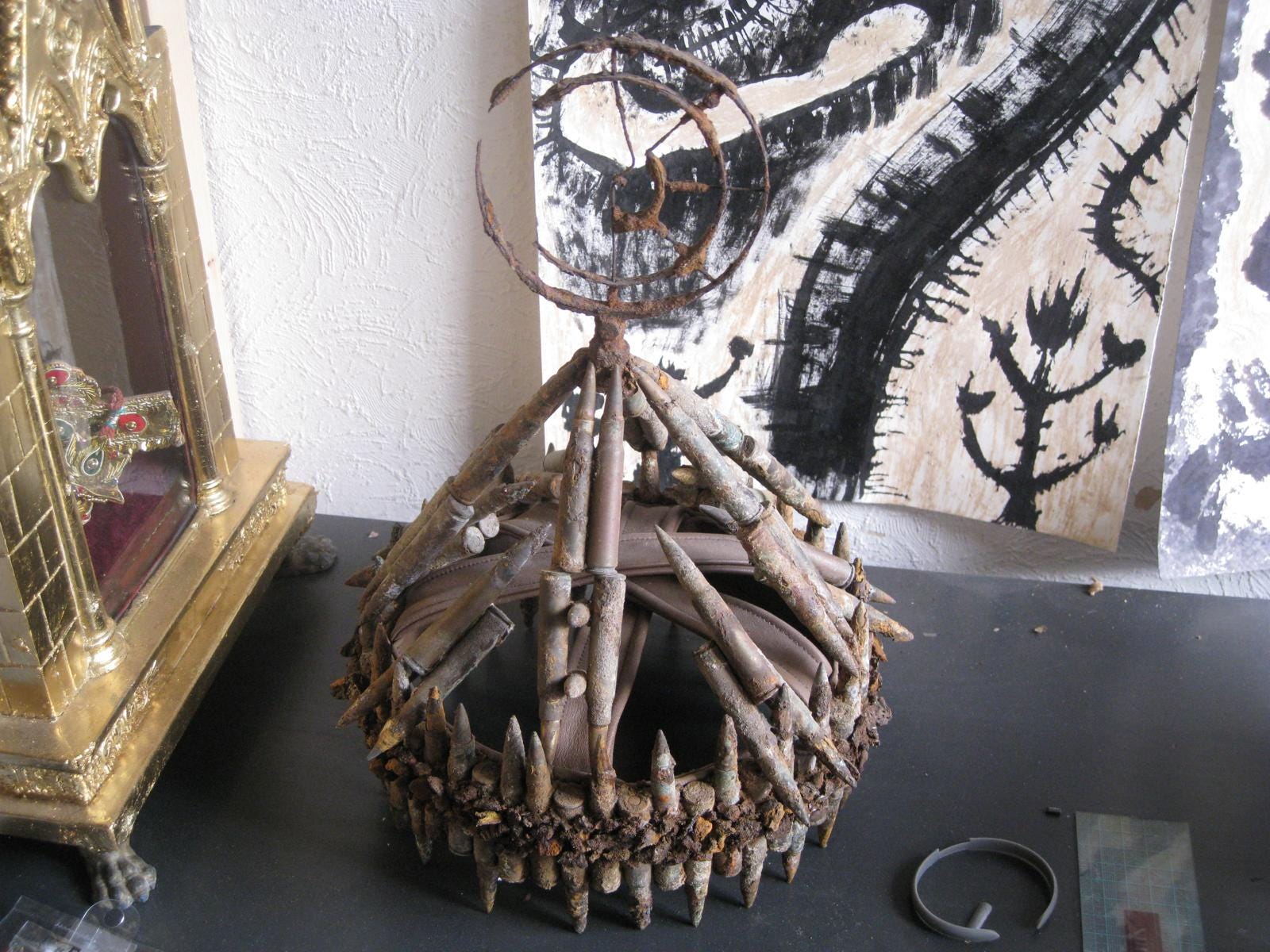
JA: This is a reliquary that we’ve just restored. Inside, there’s an Indian gold-embroidered crown.
Now, guess what this is made of.
LPT: That’s exactly what I’m wondering. Can I touch it? They look like... How do you say it in French? Like little... Are they cartridges?
JA: They’re bullets.
They’re bullets from a Second World War bunker that I used to explore with my brothers and cousins when we were children. We discovered hundreds of rounds of ammunition.
When I was seventeen, I made crowns out of them.
I even made the little leather headpiece underneath, so the crown could be worn more comfortably.
LPT: Was this your first creation?
JA: My first sculpture. My first sculpture made with the awareness that I was creating a work of art. I’d made things before, but without really thinking of them in those terms.
LPT: Was that the moment when you realised you could actually create something? I wanted to ask you about your background and how everything started, but was this the turning point?
JA: I’d already been thinking about it before, but more in relation to fashion.
And in a way, the crown is a fashion accessory.
Originally, I wanted to create a fashion brand and design entire collections of clothes.
I really liked Olivier Rousteing’s creations on that note.
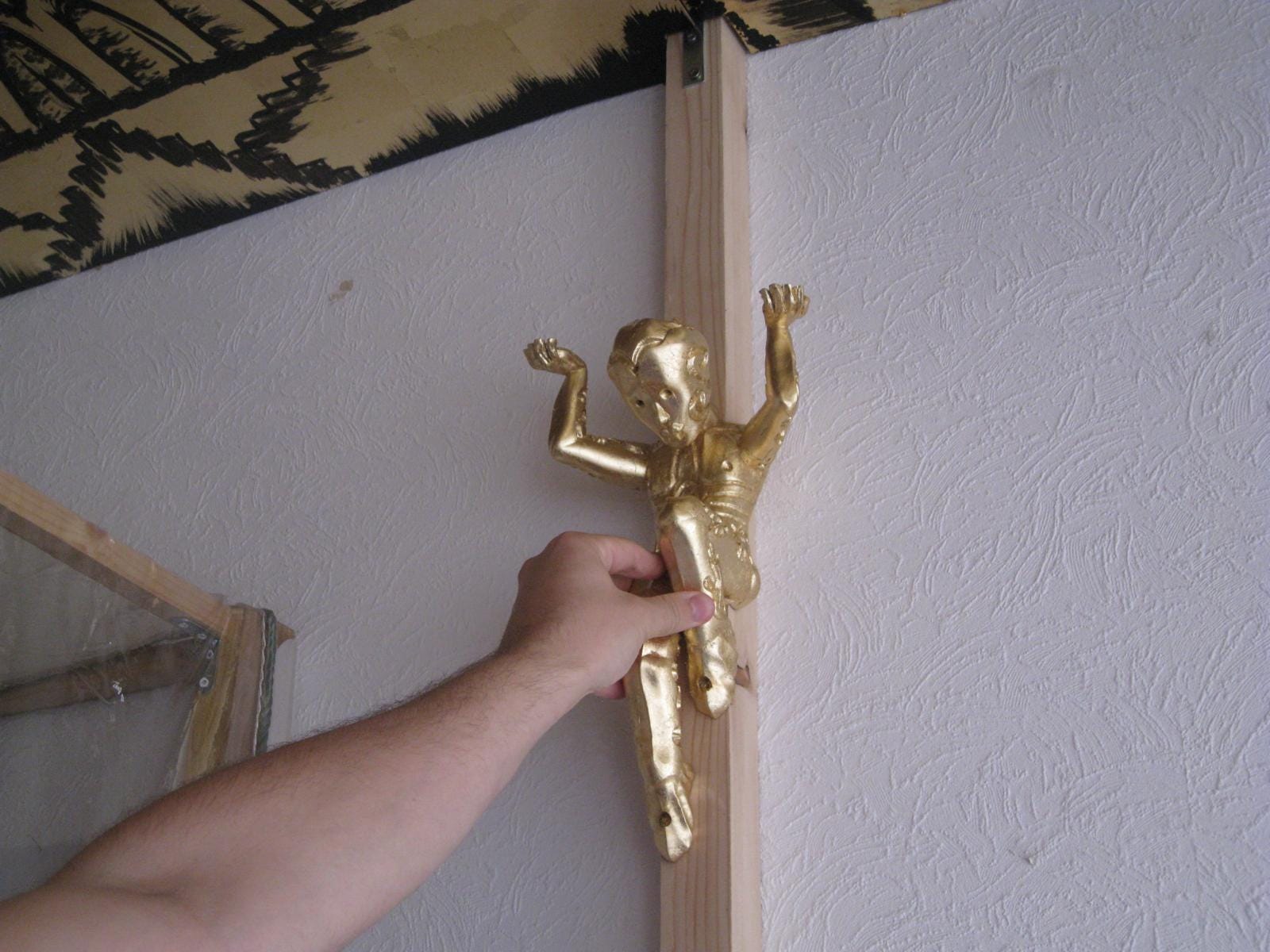
Here, there’s a little penitent figure that screws into the wood. It’s part of the ceiling installation.
The ceiling still needs some work. It’s Chinese ink on wood, on fir. There’s quite a lot left to do. You can see the false ceiling over there.
And these are tests using Armenian volcanic stone.
LPT: You learned to sculpt volcanic stone in Armenia?
JA: Yes. These are just little experiments. I spent a month there.
And over here, there’s a robotic arm.
LPT: A robotic arm?
JA: It’s a prototype of an arm used in Venice. We’ve been running tests with it.
Here, these are the tools we use every day.
THE FOOL, THE CIRCUS AND THE ART OF MISCHIEF
LPT: The circus as a universe is something that really interests me. I’ve been obsessed with the circus since I was a baby. Although I don’t know whether it’s actually the circus or the medieval figure of the fool that fascinates me more. I think the two are connected somehow. What about you? What’s your relationship to that universe?
JA: For the circus, not so much. I think I’m connected to the circus almost in spite of myself.
But fools? Much more. I love fools.
A lot of my characters are figures who appear to be playing tricks. Not necessarily tricks, exactly, but they do things that could be interpreted that way.
Sometimes they overturn chalices or commit little acts of mischief.
Look at this one. He’s overturning a chalice onto a small house.
LPT: I love that.
JA: He’s being mischievous. He’s committing some kind of offence.
Although it’s not really an offence.
LPT: Did you play a lot of pranks when you were younger?
JA: A lot. An enormous amount.
LPT: What’s the biggest prank you’ve ever played?
JA: The biggest?
There are so many different kinds of pranks. Some are funny. Some aren’t funny at all.
A HEART THAT BEATS ON YOUR FINGER
JA: This is something I’m working on at the moment.
It’s a piece of jewellery. A ring.
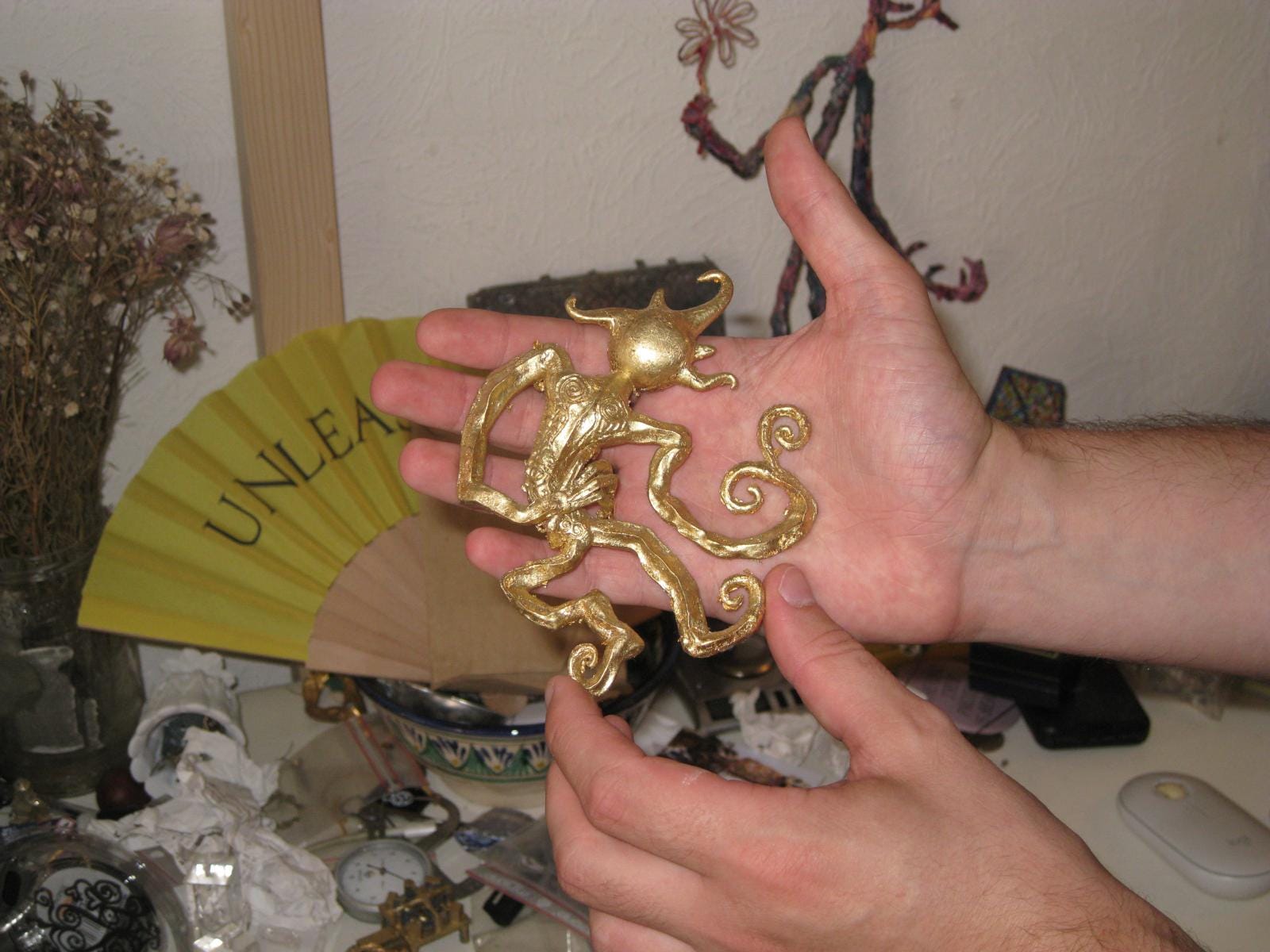
The proportions still need some work, but the concept is that when you turn the crown of the character, his heart starts beating.
So I’m first developing the mechanism on a larger scale, before miniaturising it.
It’s relatively advanced, although there are still improvements to be made.
The objective is to transform a rotational movement into a linear movement.
The idea is that the parts beneath the star rise and fall.
For now, I’ve only managed to create a very small movement.
But it’s actually a real achievement, because it proves that the rotation can lift all four parts simultaneously.
LPT: And when it’s on the ring, does the movement have something to do with the person wearing it?
JA: It’s her lover lying on her finger. It’s a portrait of her lover.
When she’s wearing the ring, she turns his crown like this, and his heart beats.
LPT: So it’s a living ring.
JA: Exactly.
LPT: And the jewellery you’re wearing, I imagine those are your own creations too?
JA: Yes.
Here, I’m wearing a portrait of my grandmother in white gold. There are little rubies in her cheeks and diamonds in her eyes. And inside, her dreams are sculpted.
LPT: Can I take a picture of that?
It’s so personal.
JA: Yes, of course.
Although my jewellery isn’t always easy to photograph. There are so many details.
COMFORT IS PART OF THE WORK
JA: This is a recent ring I made for an exhibition at the Grand Palais. It’s extremely comfortable. I also wanted it to be able to stand on its own. It’s a palace ring, an actual little palace.
And here, at the front, there’s a naked female figure lying down, relaxing, with a flower in her hand.
She’s wearing a mask.
LPT: Is comfort something you think about when you’re designing jewellery?
JA: When I make jewellery, it has to be wearable. It needs to be something that can be worn in everyday life.
I like comfort. Although I’ve also made uncomfortable things.
The crown isn’t comfortable, even if I added leather to make it a little easier to wear.
I’ve also made a pharaoh’s beard. That one is very comfortable to wear, even though it’s quite an unusual object.
But I work on the principle that if I’m selling jewellery, it should be perfect in every respect.
LPT: So it needs to be comfortable too.
JA: Exactly.
LPT: What I love is that there’s always a story behind your work. Actually, it’s more than a story. It’s not just an image. There’s movement.
JA: I love movement. There’s always something moving in my work.
It’s as if the scene is taking place in the middle of an action, as though you’ve captured something while it’s happening.
I love that.
THE MOST EXPENSIVE PRACTICAL JOKE
JA: I’m currently working on two rings. These are twin rings.
One has a 4.50-carat Zambian emerald, and the other has a 3.14-carat emerald. They’re for my best friend and me.
Basically, I want to play a prank on him. In about ten days, I’m having dinner at his father’s house. I’m going to wear my ring and show it off.
It’s going to be magnificent, with this beautiful stone. I want to make him interested in it. I want him to make a few slightly jealous remarks.
Then his father will ask to have a look at it. He’ll take it, put it in his pocket, and secretly replace it with the other ring.
Then he’ll hand that ring to my best friend so he can have a look.
Except that one will actually be his. So we’re going to see whether he notices the difference.
LPT: Now that’s a prank.
JA: Completely. It’s entirely a prank on my best friend.
And the design is very personal. My best friend is a sailor and a chef. The ring represents a boat, a kind of little rowing boat, with a palace built on top of it.
There are two thoughtful figures.
One is looking towards the sky, and the other is looking down towards the ground.
Here, there’s a character holding an anchor connected to the boat.
Another has his hand on his heart and is holding on to the boat as well.
Their legs are intertwined to form a sailor’s knot called the love knot.
It represents the love between my best friend and his father.
Filial love. Family love.
I can’t wait for the ring to be finished and for him to discover it.
LPT: And I absolutely love this prank.
ALIENOR: It’s such a good prank.
JA: I think he’s going to be really happy.
THE STORY OR THE OBJECT?
LPT: Do you think about the story first, and then the piece of jewellery? Or do they come together?
JA: It really depends.
For example, with these two rings, I knew that I wanted a big stone for mine. I don’t own any rings with large stones, and I really like them.
So I just waited until I found the right stone. As it turned out, there were two beautiful stones, so I bought both.
And I’d known for several months that I wanted to make a ring for my best friend.
I knew it had to have a boat, an anchor, and a sailor’s knot.
Essentially, I start with strong symbolic principles. And then, in the moment, I fantasise about something. Sometimes I need to turn the idea over in my head for a month before it finds a form that I feel I can present to the world.
LPT: And you tell the stories afterwards?
JA: Yes. But I don’t write them down very much.
When it comes to telling the stories behind my creations, it comes very naturally. Because, to me, it all makes sense.It’s one big story with its own internal logic.
I don’t really need to write the stories down.
And people will read what they want into the works anyway.
As for my ideas, I write them on loose sheets of paper. I draw them in notebooks.
Look, this is the chess set.
Originally, I just wanted to make a simple chessboard.
THIRTY-TWO PIECES, THIRTY-TWO OUTFITS
JA: At first, I was considering different materials for the board, including ceramics. Now I’ve decided on Armenian volcanic stone.
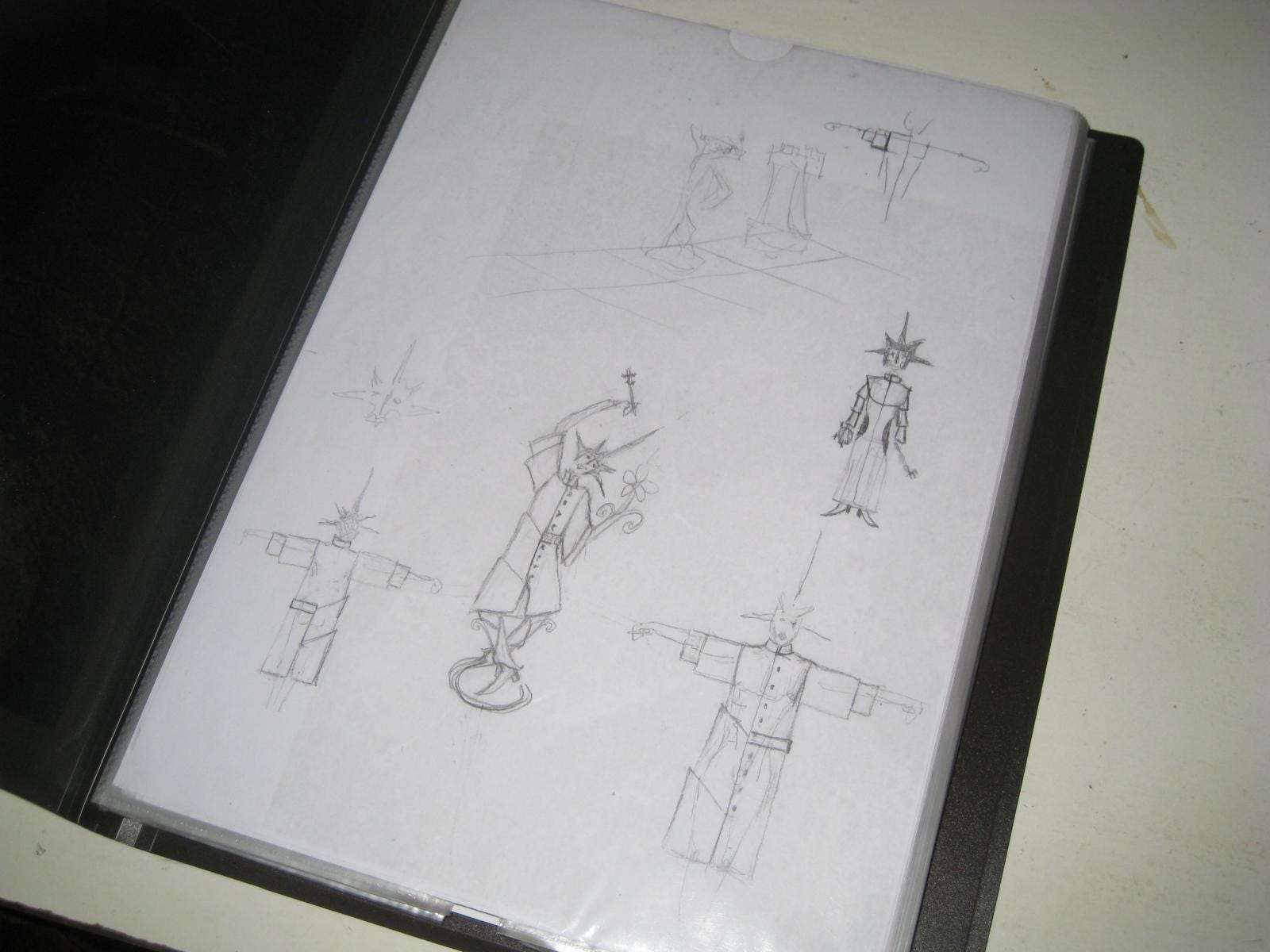
And here are the drawings. These are sketches of the embroidery, the king, the different characters.
LPT: There’s a real fashion element to all of this too.
JA: Absolutely. There are thirty-two chess pieces, with thirty-two different outfits. Every single garment is meticulously detailed. Here, for example, this is the king’s trouser leg.
LPT: Without thinking too much, which is your favourite piece?
JA: I’d say it’s between two pieces.
There’s the Child King. Let me find the drawing.
Actually, first, there’s the Black Queen.
LPT: I love her.
JA: She’s my grandmother.
I already knew what I wanted her to look like. I drew her, but I only designed the dress after sculpting the piece.
The dress came afterwards. Here, these are the technical drawings. This is the actual pattern for the dress.
By the way, what do you do at Balenciaga?
LPT: I work on the business side, so it’s completely different.
But I can see what you’re doing here.
It’s miniature fashion.
JA: Exactly.
Now, our dear Child King, who may or may not decide to appear... Here he is. He’s a portrait of my little brother when he was seven years old.
He’s a child sitting on a raised throne. Almost like a baby sitting in a high chair.
LPT: Your family seems to be very present in your creations.
Your grandmother, your brother...
JA: There are several family portraits, yes.
It’s something I do naturally.
THE ROOK WHO LOST HIS HEART
JA: The other piece I really love is one we saw earlier. Here it is.
This is the rook carrying his heart.
He’s a rook who has lost his heart, there’s a hole where his heart should be. He cries tears made of diamonds. And he climbs the steps of an infinite staircase.
In the original drawing, he wasn’t climbing the stairs, but I eventually decided that he should be.
LPT: It almost sounds like an infernal punishment.
Something out of Dante’s Inferno.
JA: There could be a connection, yes.
THERE IS NO TYPICAL DAY
LPT: I asked the same question earlier, but what does a typical day look like for you?
JA: The ideal day would be that the atelier opens at nine, although I like starting a little earlier. It depends on how much energy I have.
I do a lot of prototyping. But actually, it depends entirely on the stage of the project.
After the chess set, for example, there was a period when I was mainly having meetings with people.
Then there are periods when I do a lot of drawing. There’s a typical process, but there isn’t a typical day.
For example, tonight I’m going to have to work on some gold rings before leaving for India.
I’ll probably be working for most of the night.
LPT: You think you’ll be up for a good part of the night?
JA: I think so. I need to finish two rings by tomorrow so that I can give them to the stone setters.
RED VELVET, SILK AND VENETIAN SLIPPERS
LPT: A question that has absolutely nothing to do with anything, but since I work in fashion, I’m always curious.
You’re dressed quite casually today. Is this how you normally dress?
JA: When I’m at the atelier, yes. I almost always wear this necklace, though. Sometimes I take it off, but not very often.
LPT: Has it always been this necklace?
JA: Always. It’s the first necklace I ever made. I’ve worn it ever since.
LPT: That’s beautiful. And the ring?
JA: I wear the ring when I’m not working. I wear it a lot, but usually not during the day, unless I have meetings. This is more or less my atelier uniform.
LPT: It’s very relaxed.
I’ve seen photographs of you dressed differently, though. You sometimes wear these quite romantic shirts.
JA: Yes. Fringes, cords, laces.
I love red velvet, black velvet. I love silk.
I love fringed shirts.
And I like friulane, too.
LPT: Really? I’m actually starting to give up on those.
I’m from Rome, and in Rome people wear them a lot, just like in Venice. They were almost the standard shoe when I was in high school. Everyone had them.
At first, it was mostly girls, but eventually even the boys started wearing them.
And now, I don’t know, I just can’t anymore.
JA: I found an incredible pair in Venice. A Venetian friend took me to a particular shop and helped me find this very unusual shape.
Instead of having the usual rounded front, they end in a pointed Gothic arch.
It gives the slipper a really distinctive shape.
LPT: That’s actually really nice.
JA: Otherwise, I wear trainers. I love my Salomons.
I like them black, matte, simple and comfortable.
Or leather shoes with a flap.
INVENTING OR DISCOVERING?
LPT: I have the impression that the worlds you create exist somewhere in the past. There’s this medieval dimension to them, for example. Do you feel like you’re inventing these worlds, or discovering them?
JA: I think I’m inventing and discovering things that are inspired by many different cultures. My childhood in Morocco had a big influence on me. Islamic art, the mausoleums of Moroccan kings, the Hassan II Mosque, even the Moroccan desert.
I loved all of that.
But there’s also Catholic culture, Catholic churches, and particularly medieval goldsmithing and religious treasures.
And then there’s the entire imaginary world of treasure. The way a child imagines treasure, but also the way an adult imagines it.
For example, the discovery of Tutankhamun’s tomb.
That absolutely fascinated me. I thought it was incredible.
But also blockbuster films like Indiana Jones, or manga like One Piece.
I love One Piece because anything is possible.
There’s this elastic character travelling across the oceans in search of the ultimate treasure.
I love that.
THE TREASURES I WANTED TO FIND AS A CHILD
LPT: I have a slightly more personal question.
Since I work in luxury, I’m interested in how people relate to it.
And I think we’d agree that your creations belong to the world of luxury.
JA: Completely.
LPT: But when you were a child, what did luxury look like to you?
JA: For example, in Lego sets, there were treasures.
I was an absolute Lego fanatic. There were these little transparent coloured bricks, sometimes used for lights or decorations.
I loved them.
To me, those were precious stones.
And like many children, I collected little objects I found on the ground, things I’d dug up.
I also dreamed of becoming an archaeologist. But as I grew older, I realised that archaeologists don’t discover Tutankhamun’s tomb every day.
That was one archaeologist among many, and something like that might happen once in a lifetime. Of course, archaeologists discover extraordinary things.
A piece of fossilised wood that’s forty-five million years old is incredible.Today, I can appreciate that.
But when you’re a child, with a child’s idea of treasure, a piece of fossilised wood isn’t necessarily what you imagine.
So now, as an adult, my goal is to make the treasures I would have dreamed of discovering as a child.
It’s a kind of shortcut.
BUILDING A PALACE, PIECE BY PIECE
LPT: I’d read somewhere that you wanted to build a palace.
Is that true?
JA: That’s my dream.
LPT: But in a way, you’re already building your palace, piece by piece, aren’t you?
JA: Not exactly.
I’m building a universe that will hopefully give me the opportunity to build my palace one day.
PATIENCE IN THE MIDDLE OF A TORNADO
LPT: I imagine you work with techniques that require an enormous amount of patience. Are you equally patient in your personal life, or is that something that disappears once you leave the atelier?
JA: I think I’m resilient.
And I think resilience is one of the components of patience. If something happens, I tend to tell myself, well, that’s life. If something takes longer than I wanted it to, I generally accept it.
So I think I’m patient in everyday life too.
But it’s complicated.
For example, I worked on the chess set for three years with a team of sixty people. And you might imagine that a project lasting three years requires a great deal of patience.
But in reality, every day was a tornado.
Every day, so many things were happening. Every day was a sprint.
So you look at this very long project and assume that it must have required patience.
But every day was so intense that there wasn’t really any opportunity to be patient.
Everything was happening in the heat of the moment.
It was constant fire.
But then there are certain techniques, especially embroidery, where there’s a minimum amount of time that simply cannot be reduced.
Even when you’re in a hurry, even when there’s an enormous amount of work to do, the process takes the time it takes.
And that’s particularly true of embroidery.
LPT: Are you usually able to predict how long something will take?
JA: It always takes much longer than I expect.
Although I’m getting a little better at estimating things now.
RAPID FIRE: OBSESSIONS, TREASURES AND OTHER THINGS
LPT: I really like obsessions.
What’s the last thing you became obsessed with?
JA: Love.
LPT: What’s an obsession you’ve managed to get over?
JA: Dyeing my hair.
LPT: Really?
JA: Yes. Multicoloured hair.
LPT: What’s an obsession you think will never leave you?
JA: Treasures.
I’m obsessed with treasures.
LPT: Gold or silver?
JA: Gold.
LPT: A material you could touch for hours?
JA: My bedsheets.
Because I’m tired.
LPT: A place you return to mentally?
JA: The world of my dreams.
LPT: Past or future?
JA: Future.
LPT: Minimalism or excess?
JA: Excess.
LPT: An artist you wish you could have met, from any period in history?
JA: Fabergé, I think.
LPT: One word to describe your universe?
JA: Fantastic.
LPT: One word for Venice?
JA: Serenissima.
LPT: One word for Paris?
JA: Intense.
LPT: One word for Joseph?
JA: Determined.
IGNÉ: A WORD FOR FIRE
LPT: And your favourite word?
JA: That’s difficult.
JA: Igné.
It’s a word that can describe a kind of heat appearing in the cheeks. But it can also be used poetically.
In a poem, I used it to describe cheeks that were burning.
Instead of saying someone’s cheeks were completely red, I called them ignées.
WHEN DOES AN OBJECT BECOME A WORLD?
LPT: Your work sits somewhere between sculpture, jewellery, architecture, and embroidery. At what point does an object become a world?
JA: Instantly. For me, even a pencil stroke is already a world.
It doesn’t matter what it is. Even an industrial object is a world.
Everything is.
LPT: Your pieces almost look like relics from a civilisation that never existed. Or perhaps one that existed a very long time ago. Imagine an archaeologist discovers your work in two thousand years. What would you want them to understand about it?
JA: They can imagine whatever they want.
My sculptures aren’t there to communicate one fixed message.
They’re there to awaken whatever comes instinctively to the person looking at them. So if an archaeologist discovers one of my works in two thousand years, I’d like them to understand just as much as someone seeing it today.
In other words, I’d like them to have an instinctive reaction.
FANTASMAGORIQUE
LPT: That’s what really attracts me to your work. I love dreams, too. And I’ve always been fascinated by characters, especially the figures in chess. The rook, the king, the queen, the knight. They’ve always intrigued me. And in your work, I recognise figures that somehow speak to me.
There’s something almost reassuring about them.
JA: I think there’s an important distinction between fantasy and the fantastic. They’re not quite the same thing.
Actually, I think phantasmagorical would be a better word to describe my universe than fantastic.
Something that mixes fantasy, imagination and a surreal dimension.
LPT: What I also find interesting is that your characters seem benevolent.
I come from a Lebanese background, and there are a lot of protective symbols in our culture. The eye, for example.
You find it in Greece and Turkey, too.
And in Italy there are other symbols that serve a similar purpose.
I feel that if I had one of your pieces, it would be something benevolent.
Something that protected me.
MAKING NIGHTMARES HARMLESS
JA: You’ve actually touched on something very important in my work. I’ve had bad dreams every single night for as long as I can remember.
Every night. And I remember them.
For me, creating things is a way of transforming those agitated impressions into something harmless and wonderful.
LPT: Do most of your characters come from your dreams?
JA: Yes. Creating allows me to turn very troubled feelings into something harmless and wonderful.
And for me, an object is perfect when it produces a feeling of comfort.
A sense of wonder, or something sacred. Beauty. Meaning.
LPT: When you showed me the Black Queen earlier, and told me she was your grandmother, I felt that. When you told me she represented your grandmother, I immediately felt that if I had her in my home, I’d feel protected. I’m very emotionally attached to objects. I have things that probably mean absolutely nothing to anyone else. But to me, they mean something.
They make me feel safe.They protect me, in a way.
JA: That’s exactly it.
You can discover Joseph’s work HERE and follow along on Instagram here.
LAST PEOPLE THERE is an independent editorial project exploring art, fashion, design, architecture, and the people behind things. A collection of conversations, observations, objects, and places. We go to vernissages and notice the wrong things.