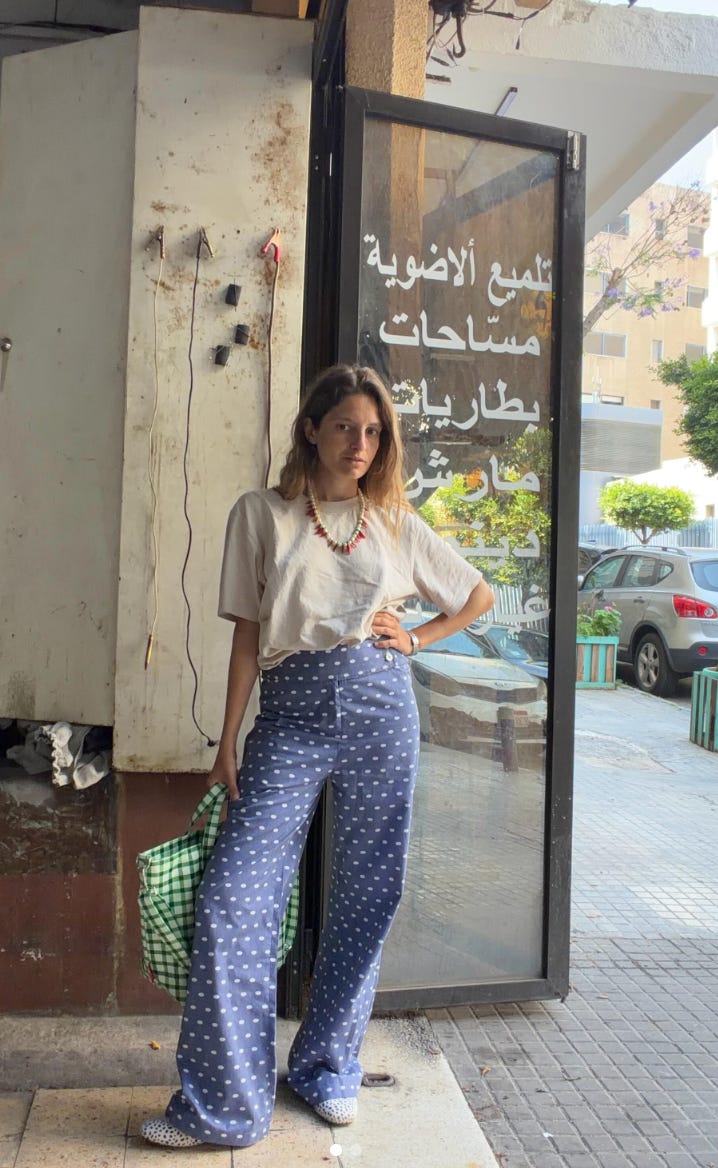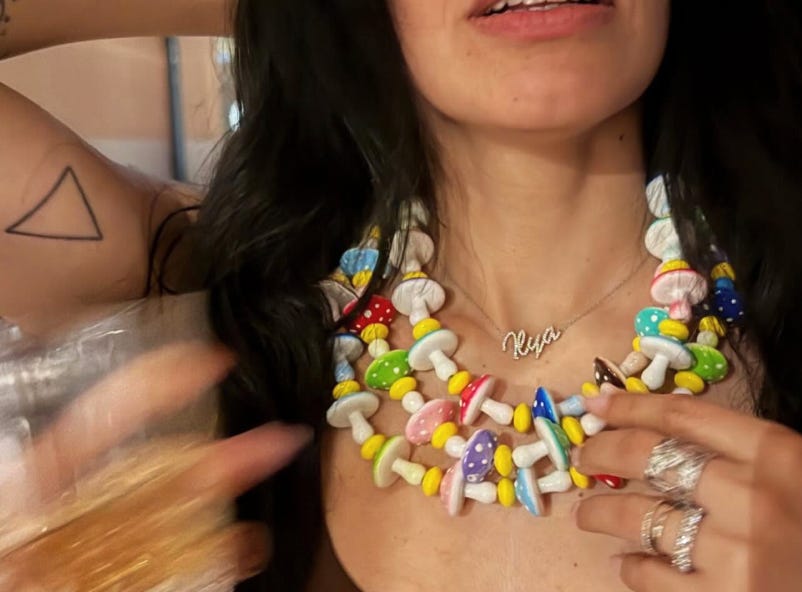

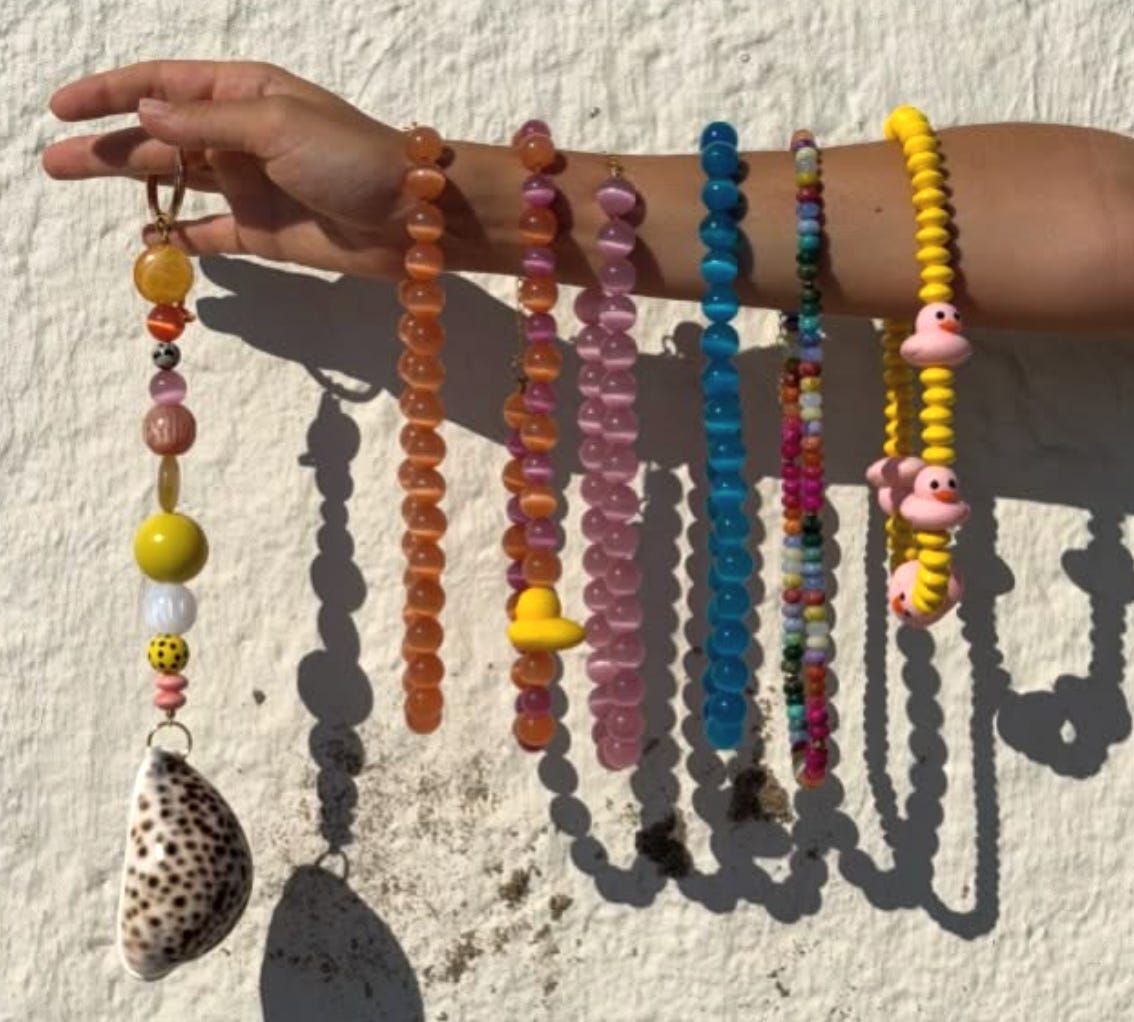
There is something immediately reassuring about meeting someone who calls herself Little Miss Busy and discovering that she isn’t particularly interested in being busy all the time. She works, she creates, she sees her friends, goes to the beach, changes her mind, and occasionally tries to invent a system for organising the hours of her day. Her jewellery follows a similar logic: bright colours, strange little characters, ducks, chillies, and whatever else happens to be in her head. It began with pieces she made for herself, before other people started asking where they could get them.
We met in Paris and started with the things you are supposed to ask someone who has built a brand: where the name comes from, how the objects are made, and what happens next. Very quickly, as usual, we found ourselves somewhere else. We talked about the impossible standards of being a “cool girl,” the Mediterranean as a kind of cure, growing up attached to Beirut and wanting to leave it, and the difference between liking a city and finding your people in it. There were detours through Coca-Cola, blonde roots, dogs, things we might regret losing, work we don’t want to do forever, dating in Paris and a plan to bring independent brands together in pop-ups. I like interviews that leave room for the conversation to become something other than what I originally planned. This one did exactly that.
On Being Busy (Or Not)
Y: I want to start with your name. Are you actually always busy?
L: My brand name? No, not really. But you can be busy seeing your friends, seeing your family, going to the beach, things like that. Busy working? Not really. I work about four or five hours a day.
Y: I like having a rhythm. Are you methodical in the way you work? I’m quite impulsive myself.
L: When I started doing what I do, I knew nothing. Now I know more, but methodical? Zero. Absolutely zero. I love talking to people and meeting people. I learn so much from them. Now I’m a little more limited by the people I can meet in Lebanon, and I want to develop a more methodical approach. Two days before travelling, I started writing down how I spend every hour of my day, to try to build some sort of system. Usually I’m very go-with-the-flow. I have big things I plan, big events, but I know I need to start planning the smaller things too. In general, am I organised? Not really. Not at all.
Y: When would you write down what you did? After every hour or at the end of the day?
L: More or less at the end of the day.
Y: I go through extremes with writing. Either I write absolutely everything or I write nothing. I have periods where I document every little thing and periods where I don’t write at all. I can’t find the balance. I saw in your posts that you started making jewellery because you couldn’t really find anything funky enough, right?
L: Yes. Now that I’m in the industry, I know so many brands that make fun things. But when I started, especially in Lebanon, there weren’t many doing this style. Internationally there are loads of them.
Y: When you started, were you making them just for yourself?
L: Only for myself.
Y: Only for yourself. So when did it become an actual name, a brand, rather than just something you did?
L: Little by little. People started complimenting what I was wearing, and then people wanted to buy it. I also love entrepreneurship, I love selling things, so I went into it.
Y: To to me your pieces are characters. I chose Frank, for instance, and I didn’t even think twice. I opened the website, saw Frank and thought, khalas, that’s it. I don’t need to look at the others. It was speaking to me. I love monkeys, and he reminded me of Paul Frank. He’s really a character. Do you imagine different necklaces for different personalities or moods?
L: Not really. Because I’m not that organised!
I’m lucky I have a flow. I tend to respond to things people like. People love ducks, for example, so I’ve made several designs around ducks. Or people love chillies, so I explore different ideas around chillies. But those ideas also just come to me. I can pick up one bead and immediately imagine a hundred thousand different designs, a thousand ideas. I try to make little categories for people, but I don’t really think in terms of different types of customers. When I create, I think about what’s in my head, and what I want, before thinking about what will sell or who will wear it.
Making a World, Not Just Jewellery
Y: So there is impulsivity in that. That moment when you have an idea and want to make it immediately.
L: There used to be much more of it. Now I control it more.
Y: That’s important. I’m exactly like that. I suddenly think of someone I want to interview, and immediately want to write to them. Then I have to tell myself, slow down. Think about it. Is this really worth doing? Is this person worth the time? Because you realise you can’t interview everyone.
L: Exactly. I’ve started choosing where to put my energy because I want the entire project to grow. I’ve realised it’s more about world-building than creating one product after another. I don’t want to make something every time an idea comes into my head. I’m learning to manage my time and my energy, especially my time.
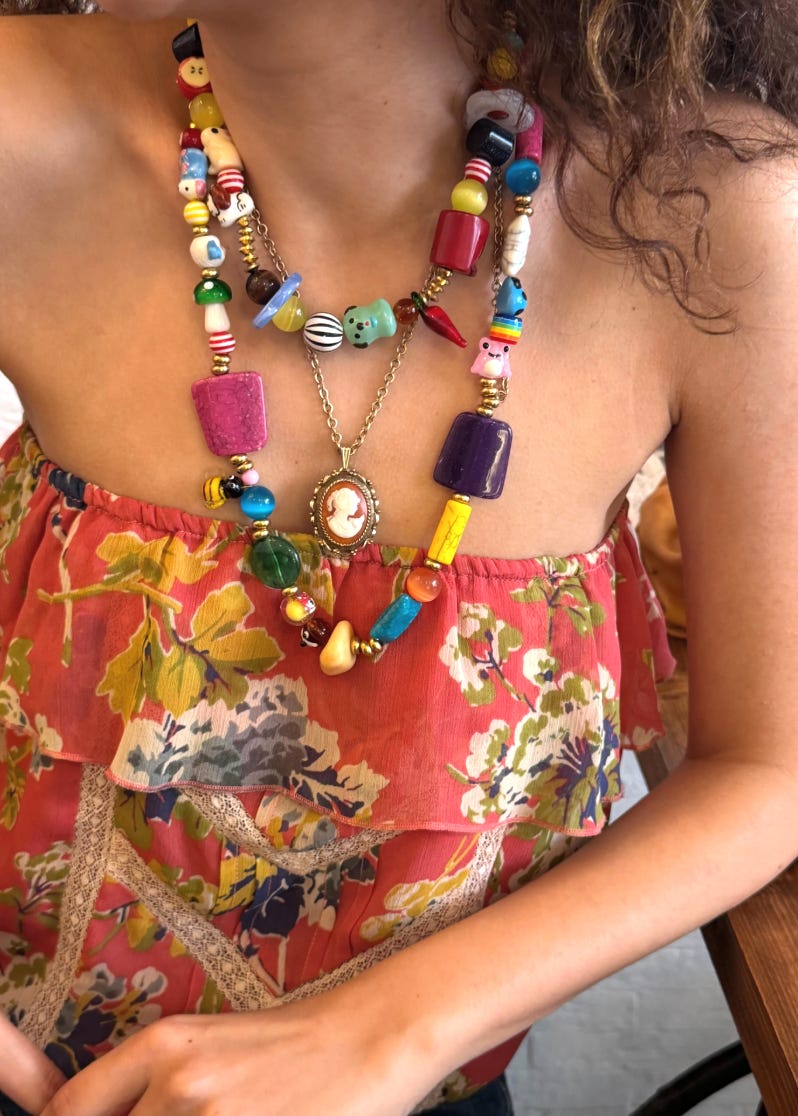
Y: It’s not only about not putting all your eggs in one basket. It’s also about not putting your eggs absolutely everywhere.
L: Exactly. Exactly.
Y: Your jewellery is incredibly colourful and bold. Is that reflected in your personal fashion style too?
L: Yes. I’ve noticed that a lot of my friends are shy when it comes to clothes. I’m not really like that. If something speaks to me, I’ll wear it, regardless of its structure, cut, size or colour. I wear a lot of colour because it makes me happy. But on a normal day I’ll often wear jeans and something basic, because I don’t always have the patience to put together an extravagant outfit. In general, though, yes.
Y: There’s a concept in fashion that I absolutely hate: the “cool girl.” I’m going to contradict myself, because to me you are a cool girl. But I hate the term, and I don’t even know how to define it. Sometimes you meet someone and you just know they’re cool. What does cool mean to you?
L: First of all, if someone is making posts saying “cool girls do this” and “cool girls do that,” they’re already not a cool girl. But that’s a good question. What is cool? I used to ask my friends what compliment they most liked receiving. We all thought about it a lot, and I realised I love it when people describe someone as cool, or nice. To me it’s just a vibe. A snob isn’t cool at all. Being inclusive is cool. Being chill, easy-going, not selfish. That’s the kind of person I find cool. It’s a vibe more than a look.
What Makes Someone Beautiful
Y: I have a similar question about beauty. Is there something you find beautiful that other people don’t necessarily see as beautiful? It doesn’t have to be physical. It could be a quality, a person, a way of being. I find certain kinds of imperfection really beautiful, especially in people I know.
L: Let me think. Beautiful... I find intelligent, interesting, engaged people beautiful. People I can learn something from when we talk. I love people who care about causes, like animal rights, economics, improving ordinary people’s lives, sociology. I find that beautiful and important.
Y: Do you try to bring those values, that sense of engagement, into your brand?
L: At the beginning I wanted to express too much through my brand. One of its big pillars is breaking social norms, so yes, those values are there, but not as explicitly as they once were. I’ve learned to separate my brand from certain other things. For example, I know I don’t care about being rich. I want my brand to grow as much as it possibly can. If one day it makes a huge amount of money, I don’t want to have a more luxurious life than the life I have now. I feel like what I have today is already the maximum I need. Anything beyond that would be too much. If I succeed, I’d love to give the rest away.
Getting Dressed, Dogs, and Coca-Cola
Y: I love that. When you’re getting dressed, does the jewellery come first or last?
L: Last. But I don’t care whether everything matches. I wear whatever I feel like wearing and then add the jewellery.
Y: How do you choose which piece?
L: Whichever one I love at that particular moment.
Y: Do you have a piece you keep on for years? Some people have a necklace or something they almost never take off.
L: No, I don’t have that. I don’t really wear fine jewellery. I wear jewellery and accessories that are made to be put on and taken off. That’s how I like them.
Y: What’s something you love looking at?
L: My dog.
Y: That’s such a good answer. Dogs are wonderful and also overwhelming. Speaking of which, my mother hates my blonde hair.
L: I love it.
Y: She hates the roots. I don’t care, I like the dark roots.
Why are you drinking Coca-Cola with a spoon? Like it’s soup?
L: I don’t know. I felt like having some.
Y: Are you going to finish it?
L: Of course. In a second. I love Coke.
Y: I love Coke too. I had this long anti-Coke phase, literally years, and then one day I thought, actually, I love it. Now I drink it almost every day.
L: Me too. Do you drink alcohol?
Y: A little, but not much.
L: Same.
Y: I went through a period of drinking a lot, and then a period of drinking practically nothing. It depends on the people and the mood. One of my best friends loves drinking, so whenever I go out with him, I know we’re going to drink.
L: I know exactly what you mean.
Y: And that’s okay. I actually have some questions about Beirut.
L: Go for it.
Beirut, Belonging, and the Mediterranean
Y: My relationship with Beirut is complicated.
L: I think there are a lot of Lebanese people who didn’t grow up in Beirut who feel insecure about it. They don’t have friends there and feel like it’s difficult to integrate. I don’t know why, because I also know Lebanese people who didn’t grow up there at all, who visit as adults almost like tourists, and love it.
So I think it’s partly about your relationship to the social scene. Beirut has a complicated social scene, but Paris does too. There are circles in Paris that are very cliquey and exclusive. The difference is that Paris is a much bigger city, so it’s easier to find your own people. I love my life in Beirut because I grew up there. I’m very attached to my childhood, maybe less intensely now that I’m older. I used to spend so much time with my grandparents and all my family, my cousins and aunts.
Those memories shaped my attachment to Lebanon and Beirut. And I’m deeply attached to the Mediterranean. Really. The sea is like my cure for life. The sea, the sea. And the Mediterranean is the sea I know. I love going up north, where my family has a place. I’m also very attached to my friends. I love my social life, but I don’t let myself be completely influenced by it. There are aspects of the culture in our circles that I dislike, the superficiality and all of that. I’ve learned to live with both sides.
The beautiful thing about Paris is that you meet so many people. If you want to advance in your career and really make it, you need to be somewhere big. Someone in Beirut doesn’t have the same opportunities or connections as someone in New York. But you can still use your free time well, spend time on your own, take classes and explore your interests.
I love being online, reading Substack, discovering my own little things. I know how to occupy myself both socially and outside my social life. One thing I notice in big cities is that during the day there aren’t that many people I can just call and see. In Beirut, I have friends I can call on any day of the week, at any hour, and we can go for coffee. I have a nice balance there.
Y: So Little Miss Busy is happy in Beirut.
L: Sometimes more than others.
Y: Do you think Beirut has given Little Miss Busy something that wouldn’t have happened if you’d started the brand in Paris? Certain meetings, opportunities, experiences?
L: I’m still wondering what the essence of Little Miss Busy really is. I haven’t fully found it yet. As for Beirut, I don’t know. There are definitely people I’ve worked with and learned from. But I can’t know what would have happened if I’d started somewhere else.
Y: You’ve been coming to Paris quite a lot. Could you imagine moving here?
L: I want to move here. I’m willing to accept the difficulties of living in a big city because I want to give the project a chance to grow. I’ve developed it to this point, and now I feel the world needs to see it. For that, I need to be in a bigger city.
Y: When you’re in Beirut, what do you miss about Paris?
L: I have a love-hate relationship with Lebanon. More love than hate, of course, but still love-hate. What do I miss about Paris? Nothing, really, apart from meeting people. Professionally, it’s easier to meet connected people. I can also meet people who interest me in different subjects.
Little Miss Busy’s Address Book
Y: Somewhere in Beirut that feels like home?
L: I spend a lot of time in Gemmayzeh. My shop and Art House are next to each other, so I’m around those two places all the time.
Y: Somewhere to go for a drink?
L: Also Gemmayzeh. Pretty much any bar there. Lately I’ve been going to Standard a little, but I don’t really have one specific place.
Y: Somewhere to go when you want to be alone?
L: Probably somewhere by the beach. I actually really like being alone. I don’t have that constant need to be with people. I enjoy having time to myself.
Y: I can see that. If I had only twenty-four hours in Beirut, what should I do?
L: Just go, sit in cafés and chill all day. And go to Raouché to see the sea. Spend some time there.
Y: And now Paris. If you moved here, what neighbourhood would you want to live in?
L: Somewhere between the 3rd and the 11th.
Y: When you visit, you’re usually staying in the 16th. You wouldn’t want to live there?
L: No. It’s boring. It’s comfortable, which is nice, but not somewhere I’d want to live.
Y: The 3rd and 11th have much more going on. Any favourite addresses in Paris?
L: Not really. I go wherever my friends tell me to go. I’m happy sitting on practically any terrace. I don’t get particularly hyped about a specific address.
The Things We Keep
Y: I’m obsessed with objects, and I have a whole section in my interviews devoted to them. I think they can tell you so much about a person. What’s one object you own that you would be genuinely sad to lose?
L: I’m not very attached to objects, honestly. I’m much more attached to people. I’m trying to think of something that would genuinely upset me to lose, but nothing really comes to mind.
Y: I don’t think I could answer that question easily either. Maybe that’s why I back up my interview recordings onto my laptop or iCloud. It’s one of the only methodical things I do, and I don’t even do it every night. If I lose this recorder, I can’t just tell someone, “Sorry, I lost our interview, let’s do it again.”
L: Exactly. I’m not very materialistic. I’d love to own something vintage with a really meaningful story, but right now I don’t have an object I’m particularly attached to.
Y: Is your style more minimalist or maximalist?
L: Neither. I love getting dressed and I have an expressive style, so I wouldn’t call myself minimalist. But I’m also not someone who shops constantly. I’m very intentional about what I buy and what I keep.